

From a pile of documents to a timeline you can walk in with.
Here's exactly what happens between dragging in your first file and walking into your meeting prepared. Nine stages, no jargon, nothing hidden.
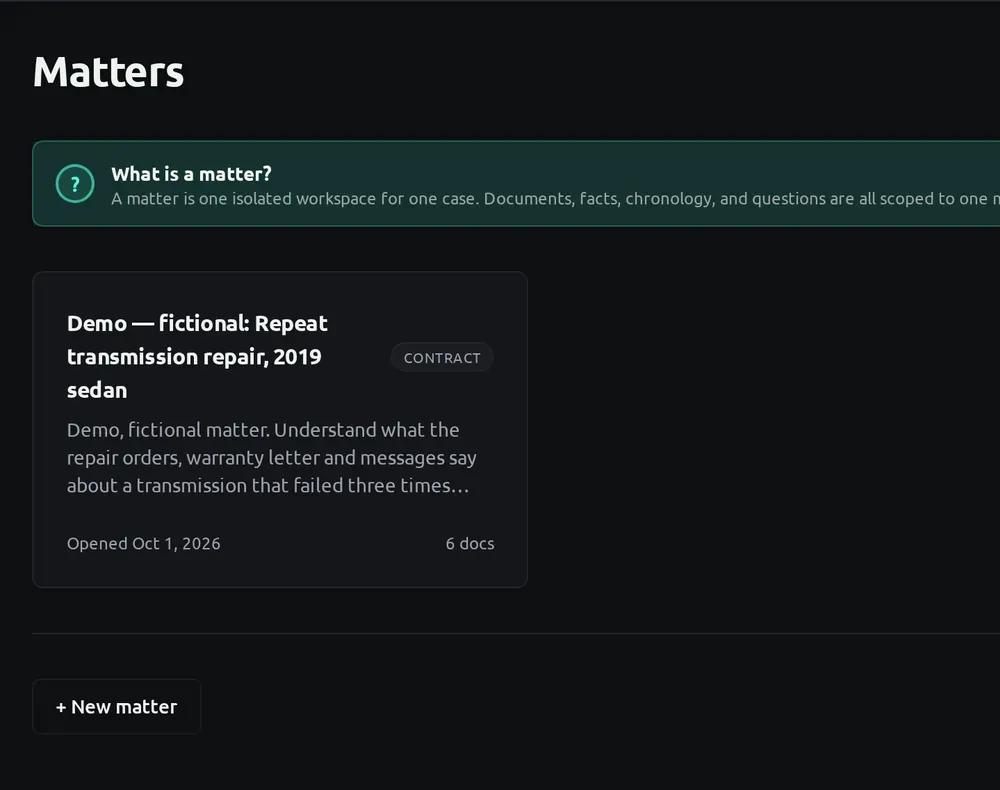
01 — Frame the matter.
A few plain-language fields. Not an interrogation.
You describe what you're dealing with in a few plain-language fields. Aetherframe sets up a private workspace and a frame for everything that follows. From this point on, every document, every fact, every question is anchored to that frame.
02 — Bring everything in.
Drag in folders. Photograph paper. Drop in screenshots and exported threads.
A live feed shows each file being received, fingerprinted, read, and sorted. You can walk away and come back — it runs in the background. The intake meets you where you are: messy, partial, mixed formats. The system quietly turns it into something structured without making you feel disorganized.
Demo — fictional: Repeat transmission repair, 2019 sedan
Demo, fictional matter6 documents
- 01-repair-order-RO-1001.txt
- 02-repair-order-RO-1044.txt
- 03-email-thread-service-manager.txt
- 04-warranty-letter.txt
- 05-text-messages-export.txt
- 06-payment-receipt.txt
14 events · built from 63 confirmed facts
-
Repair Order DM-1001 opened.
01-repair-order-RO-1001.txt -
Repair Order DM-1001 closed.
01-repair-order-RO-1001.txt -
Payment receipt #DM-R-5521 issued to Sam Demo, applied to Repair Order DM-1001.
06-payment-receipt.txt -
Repair Order DM-1044 opened.
02-repair-order-RO-1044.txt -
Pat (Demo Motors) informed Sam that the torque converter was on backorder with an ETA of 5–7 days, that no loaner vehicle was available, and that the repair would be covered under warranty reference DM-1001.
05-text-messages-export.txt
03 — Aetherframe reads it all.
You don't have to read four hundred pages to know what's in them.
Every document gets a one-paragraph summary, a list of the people and dates it mentions, and a set of suggested facts — each one shown right next to the exact sentence it came from. You accept the ones that matter, edit the ones that need a tweak, and dismiss the rest. You can edit or remove any fact Aetherframe pulls from your documents.
01-repair-order-RO-1001.txt
invoice · transmission repair and warranty terms · 839 B · 835 chars
sha256 e53415e09534…Page 1
DEMO — FICTIONAL DOCUMENT (sample data for product screenshots)

DEMO MOTORS SERVICE DEPARTMENT — REPAIR ORDER
RO #: DM-1001            Date in: 2026-03-04       Date out: 2026-03-07
Customer: Sam Demo
Vehicle: 2019 Example Sedan LX, automatic transmission
VIN: DEMO0000000000001   Mileage in: 41,220

Customer concern: Harsh shift 2nd to 3rd gear, shudder at 35-45 mph. Check-engine light on.
04 — The timeline builds itself.
The single most useful thing most people get out of Aetherframe.
Every dated event across every document assembles into one master chronology — read it as a list, a calendar, or a visual track. Each event links straight back to the document that proves it. Filter by person, by issue, or by date range. Add events the documents missed but you remember. The story becomes coherent.
Chronology
14 events · built from 63 confirmed facts
05 — Organize by what matters.
From 410 undifferentiated documents to the handful of issues your case actually turns on.
Group facts and documents into the issues that matter — schedule and exchanges, financial records, communication patterns, whatever your situation needs. Aetherframe suggests; you curate.
06 — See what you'd have missed.
You see what to look at next. You decide what it means.
Chronology
14 events · built from 63 confirmed facts
07 — Ask your own case anything.
Answers come with the file, page and passage.
Type a question in plain language. Get an answer drawn from your own documents, with the file, page and passage. Ask something it shouldn't answer — will I win, is the other side lying, what should I argue — and it gently redirects to what it can do: show you what the record says, and help you prepare that question for your professional.
Ask your case
What does the record show about what the repair warranty from RO DM-1001 covers, and what each party said about coverage?
Answer
The repair order itself states the warranty runs "12 months / 12,000 miles parts and labor" on the work performed at that visit . That work was a transmission fluid exchange and a solenoid pack replacement (part DM-SOL-22) . The $1,045.00 payment is confirmed by your receipt dated 2026-03-07 .
The Customer Relations warranty letter narrows this further, specifying that the DM-1001 repair warranty "covers the parts installed on that visit (solenoid pack)" — and notes that the factory powertrain warranty had already expired at 36,000 miles, so there is no overlap there .
The service manager's email states the warranty runs to "2027-03-07 or 53,220 miles," and that diagnosis is covered under it — but says a full transmission replacement "would be a separate customer-pay repair, estimated $4,800" .
Ask your case
Will I win?
Refused
I cannot predict how a court will rule, what anyone else will do, or how your matter will end. Outcome prediction is outside what this tool is for.
I can show you what your documents say about the question you raised, and help you turn it into a question you bring to your attorney. Want me to do that instead?
08 — Prepare for the meeting.
Understanding turned into the most valuable thing you can bring a professional.
Aetherframe helps you turn understanding into a tight set of questions, each tied to the facts that raised it, and a clean packet: your timeline, a list of the key documents, and your questions — assembled in one click. You walk in informed, not overwhelmed. Your professional starts at minute fifteen instead of minute one.
Prepare for counsel
- docs
- 6
- facts
- 63
- events
- 14
- questions
- 2
- observations
- 4
- gaps
- 2
09 — Keep it current.
New document? It slots into the existing timeline.
Drop in a new filing, a new message thread, a new medical record — Aetherframe places it on the timeline, links it to the issues it touches, and flags anything new worth your attention. Your frame stays current without you ever starting over.